
In today’s competitive B2B landscape, traditional lead-based marketing often falls short. Businesses generate volume, but struggle with relevance, long sales cycles, and misalignment between sales and marketing teams.
Account-Based Marketing (ABM) offers a different approach. Instead of casting a wide net, ABM focuses on specific high-value accounts, treating each one as a market of its own. This strategy allows businesses to personalize communication, improve collaboration, and drive measurable revenue growth.
Below, we explore the key benefits of Account-Based Marketing and explain why it has become a core strategy for modern B2B organizations.
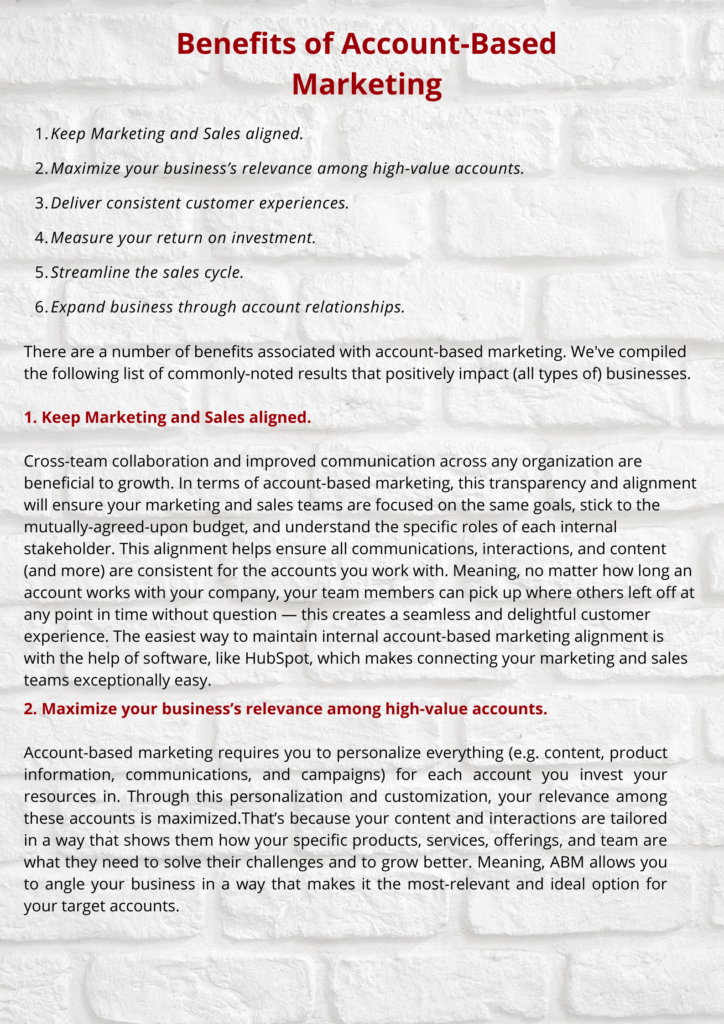

1. Keep Marketing and Sales Aligned
One of the biggest challenges in B2B organizations is the disconnect between marketing and sales. Marketing teams focus on leads, while sales teams focus on closing deals. This often results in wasted effort and missed opportunities.
ABM naturally aligns both teams around the same goals.
Marketing and sales collaborate to:
- Identify high-value target accounts
- Define ideal customer profiles (ICP)
- Create shared success metrics
Because both teams work toward engaging the same accounts, communication improves. Handovers become smoother. Accountability becomes clearer.
As a result, ABM eliminates friction and creates a unified revenue team.
2. Maximize Relevance Among High-Value Accounts
Relevance is the currency of modern marketing.
Account-Based Marketing allows businesses to tailor messaging, content, and outreach to the specific needs of each target account. Instead of generic campaigns, ABM delivers highly personalized experiences.
This personalization may include:
- Industry-specific messaging
- Role-based content for decision-makers
- Customized offers and solutions
By speaking directly to account pain points, businesses increase engagement and trust. High-value accounts feel understood, not targeted.
This relevance significantly improves conversion rates and long-term relationships.
3. Deliver a Consistent Customer Experience
Consistency matters at every stage of the buyer journey.
With ABM, customer experience remains aligned across all touchpoints. Marketing campaigns, sales conversations, and post-sale communication all reinforce the same message and value proposition.
This consistency helps:
- Build credibility and trust
- Reduce confusion during decision-making
- Strengthen brand perception
When customers receive clear, unified communication, they move through the funnel with greater confidence.
ABM ensures that every interaction feels intentional and connected.
4. Measure Return on Investment More Accurately
Traditional marketing metrics often focus on volume. Clicks, impressions, and leads do not always reflect real business impact.
ABM shifts the focus to revenue-driven measurement.
Because campaigns target known accounts, businesses can directly measure:
- Account engagement
- Pipeline influence
- Deal velocity
- Revenue generated per account
This clarity makes it easier to prove marketing value. Leadership teams gain visibility into what drives growth.
As a result, ABM delivers stronger justification for marketing investment.
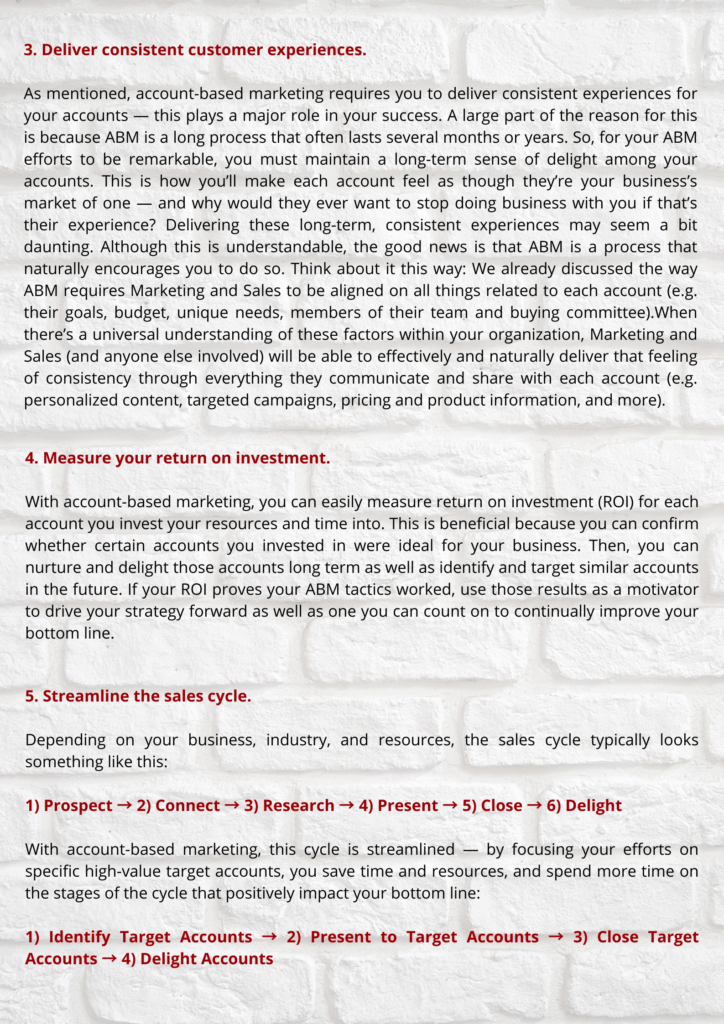
5. Streamline the Sales Cycle
Long sales cycles remain a major challenge in B2B and enterprise markets.
ABM helps shorten this cycle by engaging decision-makers early and consistently. Personalized communication addresses objections before they slow progress.
Key advantages include:
- Faster stakeholder buy-in
- Better-qualified opportunities
- Reduced back-and-forth during negotiations
When marketing supports sales with targeted insights and content, deals move forward more efficiently.
This efficiency allows sales teams to focus on closing, not educating.
6. Expand Your Brand Through Account Relationships
ABM does more than close deals. It strengthens long-term relationships.
High-value accounts often influence entire ecosystems. A strong relationship can lead to referrals, expansions, and partnerships.
Through ABM, businesses:
- Position themselves as trusted advisors
- Build deeper engagement with existing clients
- Increase lifetime customer value
These relationships amplify brand credibility and visibility within key industries.
In many cases, one successful account becomes a gateway to many others.
7. Support Customer-Centric Growth
Modern buyers expect personalization and value.
Account-Based Marketing puts the customer at the center of every strategy. Instead of pushing products, ABM focuses on solving real business problems.
This customer-first mindset leads to:
- Stronger loyalty
- Higher retention rates
- Increased upsell and cross-sell opportunities
By aligning business goals with customer success, ABM supports sustainable, long-term growth.
Final Thoughts
Account-Based Marketing transforms how businesses approach growth.
By aligning sales and marketing, maximizing relevance, delivering consistent experiences, and improving ROI measurement, ABM creates a scalable and effective path to revenue.
For organizations looking to build meaningful relationships with high-value accounts, ABM offers clarity, efficiency, and impact.
At Fortis, ABM aligns perfectly with a human-first, relationship-driven approach to business communication and growth.
How 2026 Will Transform Wireless Connectivity Forever
The telecom landscape is evolving faster than ever. From AI-native networks to satellite-cellular convergence, 2026 marks a turning point where…

CPaaS 2025: Top Trends, Innovations, and What’s Next
In an era where digital-first communication is no longer optional but essential, Communications Platform as a Service (CPaaS) has become…
Why Human-First Communication Will Define the Next Decade of Business
In an age of automation, AI, and hyper-connectivity, businesses are realizing something vital: customers crave authenticity. The companies that thrive…