
Despite all the hype around 5G, you might still be asking yourself, “What exactly is 5G, and how will it impact my business?” That question is valid, especially as wireless technology continues to evolve at a rapid pace.
Why 5G Is Considered Revolutionary
What makes 5G so revolutionary is its power and speed. Previous wireless networks could reliably support only mobile devices up to the size of a tablet. In contrast, 5G is fast and stable enough to power computers, televisions, and a growing range of smart devices.
Because of this leap in performance, many tech bloggers suggest that 5G could compete with — or even reduce the need for — traditional Wi-Fi networks in some environments.
At this stage, you may still wonder: “If both 5G and Wi-Fi are wireless internet, what is the real difference?”
5G vs Wi-Fi: What’s the Difference?
Although both technologies provide wireless connectivity, they operate very differently.
Wi-Fi is unlicensed internet, while 5G operates as a licensed cellular network. When you use Wi-Fi at home, you pay an internet service provider, such as Comcast, to deliver and amplify a signal inside your house. In contrast, you pay cellular providers, like AT&T or Verizon, to access 5G through signals transmitted from cell towers.
Infrastructure: How 5G Networks Work
From an infrastructure perspective, 5G signals originate from a main tower in a centralized location, such as a city center. Smaller towers, often called small cells, then amplify that signal across surrounding areas. Together, these small cells provide wide coverage and consistent high-speed connectivity.
Cellular providers license and operate these networks, which means companies like Verizon and AT&T control access and performance.
Wi-Fi works differently. Internet providers send radio waves from large, centralized systems through physical connections, such as ethernet cables. These signals reach your modem, which decodes them. A router then amplifies the signal so multiple devices can connect wirelessly within a limited area.
Why 5G and Wi-Fi Will Coexist
At first glance, Wi-Fi and 5G may seem interchangeable. In practice, they serve complementary roles.
The most noticeable difference is speed. 5G offers faster performance in many scenarios. Another distinction lies in how each technology connects users. Wi-Fi links devices to the internet through local networks, while 5G connects devices directly to a cellular network.
Although the technologies appear similar, experts agree that we will need both for the foreseeable future.
For example, Wi-Fi already exists almost everywhere, while 5G coverage continues to expand. If your home sits outside a 5G coverage area, Wi-Fi remains essential. On the other hand, 5G becomes valuable when Wi-Fi connections perform poorly or lack stability.
Ultimately, these technologies will work together to deliver seamless digital experiences for users who browse, stream, and communicate online.
Living in a Hyper-Connected World
We already live in a hyper-connected society. While 5G will not change everything overnight, it will strengthen many existing digital strategies. At the same time, it will open doors to new technological opportunities, especially in augmented reality (AR), virtual reality (VR), artificial intelligence (AI), and smart devices.
If you work in small business marketing, your daily tasks will not change immediately. However, subtle shifts will begin to appear as new tools and platforms emerge.
Although some developments may take time to affect your workflow, the speed of 5G will likely streamline online marketing tasks sooner rather than later.
Overall, improved 5G and Wi-Fi networks will benefit businesses with a strong digital presence. This advantage becomes even more critical for marketers who manage most of their processes online.
Five Ways 5G Will Impact Marketers
To help you prepare for the next phase of wireless connectivity, here are five ways 5G could influence marketing in the near future.
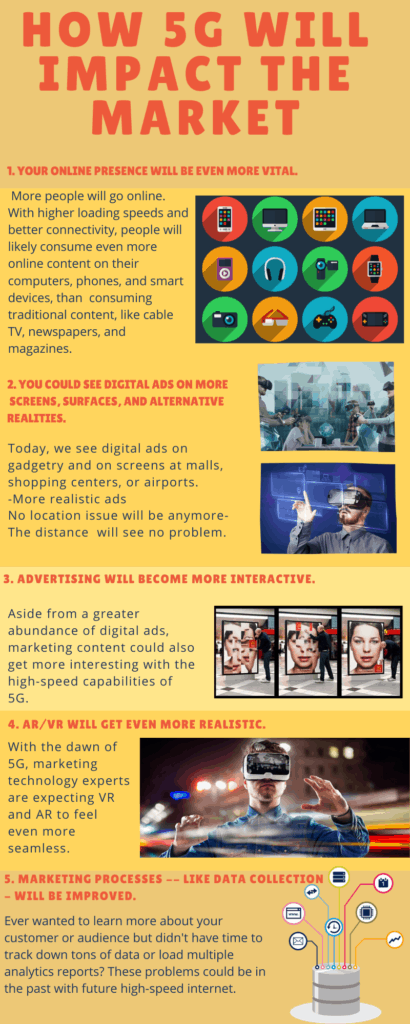
1. Your Online Presence Will Matter More Than Ever
If you think people cannot spend more time online, think again. Faster speeds and stronger connectivity will encourage users to consume even more digital content across phones, computers, and smart devices.
If your online marketing efforts lag behind, now is the time to act. As people move away from traditional media, such as cable TV and print publications, a strong digital presence becomes essential.
To expand your reach, optimize your profiles on major social platforms like Facebook, Twitter, LinkedIn, and Instagram. In addition, consider launching a website, starting a company blog, or creating marketing videos that build brand awareness.
2. Digital Ads Will Appear on More Screens and Surfaces
Today, digital ads appear on phones, websites, and public screens in places like malls or airports. With faster 5G and improved Wi-Fi, wireless connectivity will become more widespread, even in rural areas.
As a result, advertisers will gain access to more locations and formats. High-speed networks will also support richer visuals and more advanced media.
Some brands may even experiment with augmented reality advertising. For instance, Burger King once used AR to place virtual ads over competitors’ billboards. Users could scan a McDonald’s ad through the Burger King app, watch it “burn,” and receive a coupon.
Beyond AR, faster connectivity could eventually support functional holographic advertising, although this technology still remains experimental.
3. Advertising Will Become More Interactive
In the past, buffering and technical limits made interactive ads impractical. With 5G, these barriers begin to disappear.
Marketers can now explore formats that allow users to interact directly with content. Playable ads already offer a preview of this future. These ads let users try a game before downloading it, creating a more engaging experience.
4. AR and VR Experiences Will Feel More Realistic
For years, major brands have experimented with AR filters and VR integrations. As internet speeds increase, these experiences will feel smoother and more immersive.
You can expect brands to continue investing in filters, games, and fully immersive digital environments that deepen audience engagement.
5. Marketing Processes Will Become Faster and Smarter
High-speed connectivity will significantly improve data collection and analysis. Tasks that once took hours or days may soon require only minutes or seconds.
As 5G expands, marketers and cellular providers will collect more data with less delay. According to the IEEE, 5G enables intelligent network services, massive IoT connectivity, and low-latency data transmission. Big data analytics will play a central role in shaping future networks and business strategies.
Beyond analytics, faster networks will reduce the time and resources needed for everyday tasks. Automation will handle more complex workflows, while remote teams will collaborate more easily. This efficiency frees marketers to focus on creative and strategic work.
Preparing for the 5G Marketing Era
Even if your company is not ready to invest in AR or immersive advertising, staying informed remains essential. Observing how larger brands experiment with new technologies can reveal scalable opportunities for your business.
At the same time, continue strengthening your digital marketing foundations. If 5G and Wi-Fi improvements teach us anything, it is that being hyper-connected is no longer optional.
Ensure your brand appears on the most relevant social platforms. If you have not already, invest in digital assets such as websites, videos, and blog content.
If your online presence already performs well, consider testing newer mobile platforms. While advanced AR experiences may remain costly, tools like Snapchat, TikTok, and Instagram offer accessible ways to experiment with next-generation formats.

How 2026 Will Transform Wireless Connectivity Forever
The telecom landscape is evolving faster than ever. From AI-native networks to satellite-cellular convergence, 2026 marks a turning point where…

CPaaS 2025: Top Trends, Innovations, and What’s Next
In an era where digital-first communication is no longer optional but essential, Communications Platform as a Service (CPaaS) has become…
Why Human-First Communication Will Define the Next Decade of Business
In an age of automation, AI, and hyper-connectivity, businesses are realizing something vital: customers crave authenticity. The companies that thrive…